A small number of finished pieces about unfinished work. For readers who want to see the loom, not only the cloth.
Nur Kardelen · painting, song, novel
Yellow, Jaune, Kintsugi
One idea arrived three times, in three different materials, and I did not notice until the third.
Yellow · Mürşide · joycanvas.art
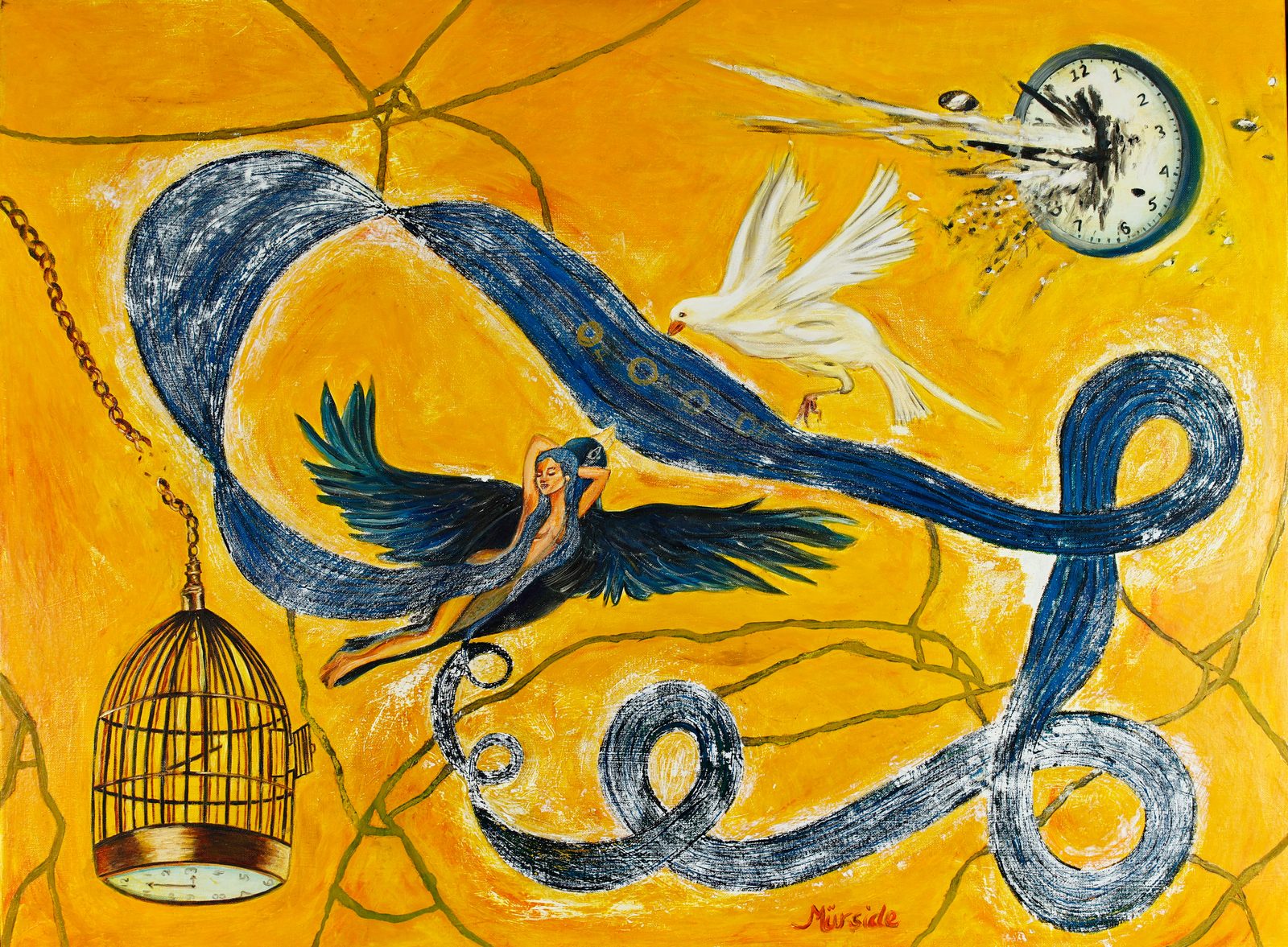
I painted Yellow before I understood what it was about. The gold is not mending an object in the picture. It runs through the whole field — the ground itself is the broken thing that was repaired. Everything else happens on top of a surface that has already been through something.
The cage is open and nobody is in it. The clocks are done. And kintsugi belongs with the chakra that governs the need to feel safe, though it took me a while to see why. You cannot gild a fracture you are still pretending is not there.
Then came the song. Jaune is in D minor, which I did not choose deliberately and would not have chosen on purpose. D major is my key, the one I return to when I am not thinking. Jaune is its shadow. It is the longest thing in the catalog, it opens veiled and quiet, it holds a dense middle far longer than is comfortable, and it does not resolve so much as stop moving. Yellow is a two-faced color. The song behaves the same way.
The third arrival was in the novel, and by then I was watching for it. The repair surfaces in Chapter 10, and again inside a lyric in Binary Blues, and both times I left them alone rather than smoothing one into the other. They are not repetitions. They are one idea in three materials, which is the only reason to work in more than one.
Nur’s dissertation runs on data I once handled myself.
As a student I was hired to download interferometer readings from the High Resolution Doppler Imager, an instrument flying aboard the UARS satellite and built in the Space Physics Research Laboratory at the University of Michigan. Ten-degree and twenty-degree readings, pulled down and filed. It was a job. It steadied a season that needed steadying.
Thirty years later I gave that work to Nur. The corridors she passes in Chapter 23 are corridors I passed. The instrument is real, the laboratory is real, and the numbers her dissertation runs on are numbers that once came through my hands.
I mention it because the novel is, among other things, about trusting a signal, and it seemed wrong to lie about the data. Very little in the book is invented that could have been found instead. The snowdrop that blooms in autumn, before its own leaves arrive, is a real plant. The orchid that drinks from the air without soil is a real orchid. Every dated chapter falls on its true 1994 weekday.
Some signals take the long way around.
Nur Kardelen · the songbook
Programmed Like a Recital
Eleven songs, sequenced by musical arc rather than by the order they occur in the novel.
The obvious way to order a companion songbook is chronologically: the song from Chapter 11 follows the song from Chapter 9. I tried it. It is unlistenable. Story order puts two quiet songs back to back, strands the brightest thing in the middle, and ends on whatever happens to fall last.
So I programmed it the way I used to program recitals. Four parts: the Door, the Weather, the Deep and the Turn, the Curtain. Alienette opens. It began as a song about me, and it works as Nur’s entrance — contemplative, asking to be loved even if she is strange. The reprise of Bouquet closes, because a curtain call should be the brightest thing in the room and should refuse to fade out.
What goes between is decided by dynamic shape, not by plot. A song that ends hushed is followed by one that opens bright. Two minor keys do not sit side by side. The peak arrives late, the way it does in nearly everything I write.
Entrance, bloom, Paris interior. Tonic and dominant neighbors; the temperature rises gently.
II. The Weather
Binary Blues (F) · Read the Room (E♭ minor region) · A Safe Storm (B♭ minor)
Irritation curdling into fury, and the fury raining itself out. B♭ minor is the parallel minor of the key the program opened in — the answer to Alienette, arriving two movements later.
Sea-glass luminescence handed forward to Jaune; the D-minor shadow resolving through joy into D major — my own key, arriving last, wearing both of its inheritances.
IV. Curtain
Bouquet (Reprise) (F minor)
The ensemble. Everyone onstage.
Lead sheets and the album to follow.
Muirgen’s Carousel · the score
Twenty-Six Numbers
The libretto was never meant to be read in silence.
The score exists. Twenty-six numbers, one hour and twenty minutes, written alongside the text rather than after it. The jacket mentions this in passing; it deserves more, because it changes how the book is meant to be held — not as a novel that happens to be set in verse, but as a libretto, which is one half of something.
Read the titles in order and you can see the book’s argument without opening it. Forms in Triplicate.Balance the Books.Guilt by the Gallon.The Clerk’s Fear.The Unsettled Tab. A town that has turned its grief into accounting, and a sea that intends to collect. The jacket promises that the ledger is open and every debt will be called due. The score is where the ledger is actually kept.
The reprises carry the repair. Sea You Later comes back four scenes from the end, longer than it was. Guilt by the Gallon answers itself immediately. And The Ocean Remembers opens the whole thing as a prelude and returns near the close without one — the same music, no longer announcing itself, because by then the town has stopped arguing with it.
Prelude: The Ocean Remembers 3:35
What’s One More Drop? 3:17
The Net is Empty 3:14
Sea You Later 3:59
Forms in Triplicate 1:59
Progress Afloat 3:52
Muirgen’s Omen 2:00
Act One, Scene 7: Why I Don’t Swim 2:59
Pints and Plastic 1:55
Oh Shite, It’s Real 2:30
Act One, Scene 9: The Storm Remembers 1:37
Balance the Books 5:48
What Floats? 3:39
You Promise / I Wail 2:54
Guilt by the Gallon 3:13
Guilt by the Gallon: Reprise 2:16
Listen 2:30
Act Two, Scene 6: The Clerk’s Fear 2:09
A Quiet Harbor 3:56
Sea You Later: Reprise 4:16
Act Two, Scene 9: The Unsettled Tab 3:19
What Remains When We Stop Blaming? 3:54
The Ocean Remembers 3:31
Storm of Mercy 2:48
Coda: Oh, Shite, Be Real 1:29
Finale: Net of Light 3:53
Muirgen’s Carousel (Original Libretto Recording), 2026. Listen on Spotify
Wilhelmina · on craft
On First Books
You can see, on the back of my first novel, exactly how much I did not trust myself.
Read the back cover of Wilhelmina, then read the back cover of At the Angle of Blue. They were written two years apart by the same person, and they are not written by the same writer.
The first one reaches. It offers a tapestry of starlight, sorrow, and awakening. It calls the book lyrical and psychological before the reader has been given anything to be lyrical about. Nearly every noun arrives with an adjective holding its hand, because I did not yet believe a noun could stand up by itself.
The second one says: by the afternoon of the day she presents it, the color is already beginning to bloom beneath her own skin. Nothing in that sentence is persuading. It trusts the reader to be alarmed.
That is the whole difference, and it is not really about prose. Overwriting is what fear sounds like on the page. When you are not certain the story is enough, you decorate it. When you know it is, you get out of its way.
I am not disowning Wilhelmina. It is a real book and it did what a first book is for: it taught me I could finish one. But I would not write that jacket now, and it seems more useful to say so than to hope quietly that nobody sets them side by side.
Lexicon
The words these books needed and did not have
Anyway
Begins as an adverb, becomes the snowdrop’s anyway, and is christened before the end. What blooms without waiting to be told the conditions are right.
Unrasterized
Not yet broken into a grid of countable units. What a thing is before it is optimized for the feed.
Miragwyn
The imprint. Named before it had a catalog.
Fieri
Latin: to become. Also a book of poems, and the only honest tense for a working practice.